




Blog
How Does Wedding Transportation Make the Day Easier? A Sacramento Wedding Planning Guide

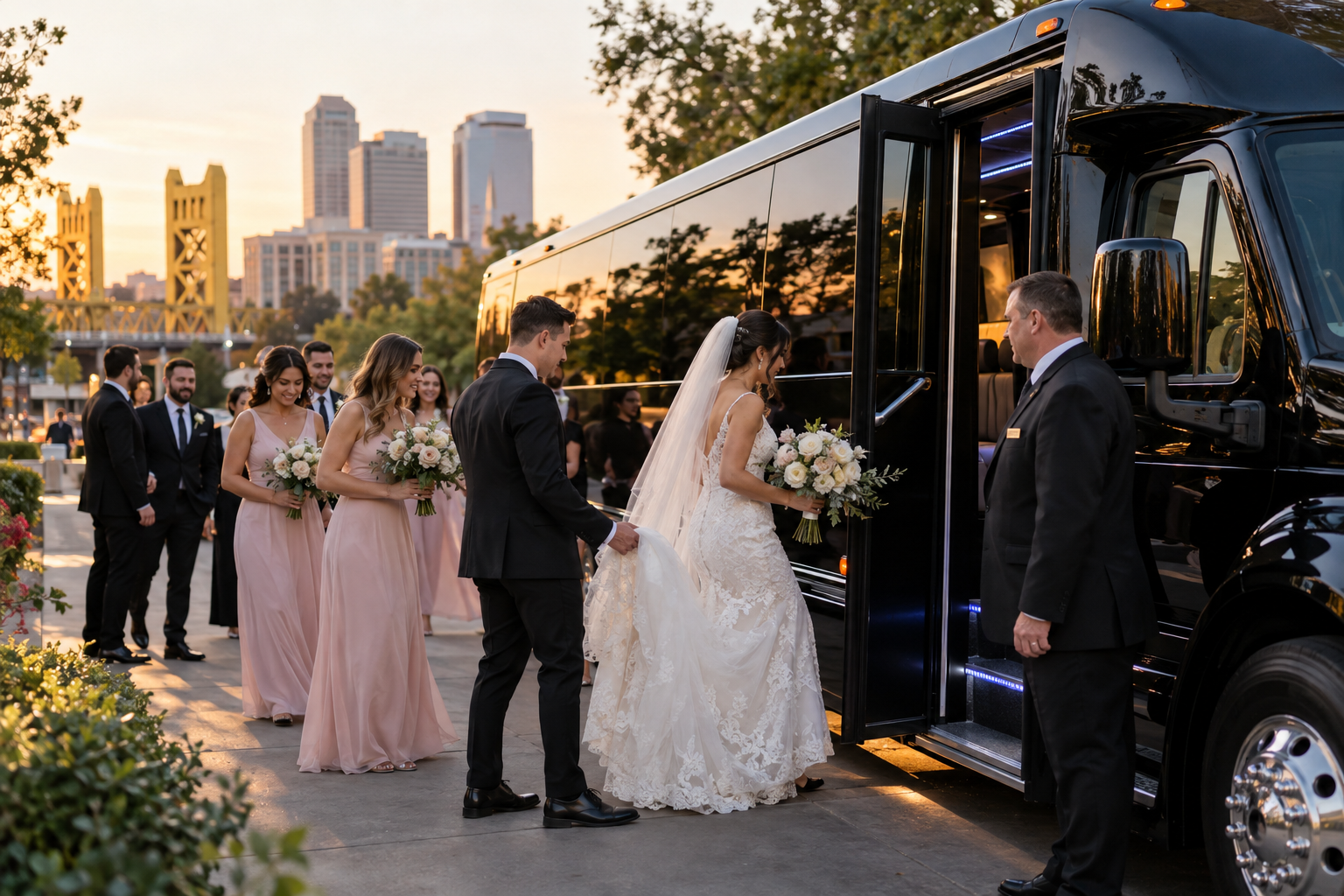
A wedding day can involve a hotel, ceremony venue, photography location, reception, and final hotel drop-off—all within a few hours. When every guest drives separately, the couple and wedding planner have to manage parking, directions, arrival times, and late-night transportation at the same time.
A well-planned wedding transportation service removes much of that coordination.
It can give guests a clear pickup point, reduce the number of vehicles arriving at the venue, protect the ceremony timeline, and provide a planned ride home after the reception.
Four ways transportation can simplify the wedding day
A coordinated transportation plan can help you:
- Protect the timeline by scheduling arrivals around fixed ceremony and reception times.
- Reduce parking coordination by moving groups together.
- Simplify guest logistics with designated pickup locations and clear instructions.
- Plan return transportation before the reception ends.
Sacramento also has several practical hotel clusters to consider. Visit Sacramento identifies Downtown and Midtown as a central area with a high concentration of hotels, restaurants, attractions, and event facilities. The organization also identifies Natomas/Airport as a hotel area north of Downtown, with Sacramento International Airport nearby.
Adding yet another challenging chore to your wedding checklist is not the aim. It is to organize transportation early enough that it removes work from the day itself.
Construct the Transportation Schedule Based on Fixed Events
The portions of the day that cannot be moved should be the first part of your wedding transportation plan.
There is a set start time for the ceremony. The reception has its own timetable. Your photographer may need the wedding party at a specific location, and the venue may control when vehicles can arrive or unload.
Work backward from those fixed events.
Your transportation schedule should account for:
- Passenger loading
- Driving time
- Traffic conditions
- Venue access
- Walking from the vehicle to the entrance
- Unloading
- Photography stops
- A reasonable arrival buffer
A 20-minute route does not automatically mean passengers should leave 20 minutes before the ceremony. The group still needs time to gather, board, settle in, and reach the venue.
How much buffer should you build in?
There is no universal number. A small group traveling between nearby locations needs different planning from several vehicles carrying guests from a hotel.
Give your transportation provider the actual addresses, passenger groups, ceremony time, reception time, and required arrival time. The provider can then help establish a practical departure window.
Perfect traffic prediction is not the goal. It is to make normal variations in traffic and loading less likely to affect the ceremony.
Organize Guests Around Actual Pickup Locations
Not every guest necessarily needs transportation.
Start by identifying:
- Wedding party members
- Guests staying at designated hotels
- Out-of-town guests
- Elderly relatives
- Guests who prefer not to drive
- Local guests who already have transportation
This gives you a realistic passenger count.
For example, guests staying in Downtown Sacramento may be able to use one centralized hotel pickup point, while guests staying around Natomas may need another. Visit Sacramento’s hotel information confirms these as distinct lodging areas, which makes grouping guests by hotel location a practical planning step.
What should guests receive?
Give guests one consistent set of instructions containing:
- Hotel or pickup location
- Exact meeting point
- Pickup time
- Destination
- Return departure time
- Final drop-off location
- Transportation coordinator’s name
Use the same information in your master transportation itinerary so guests, the wedding planner, and transportation provider work from one schedule.
Use Pickup Waves Without Creating an Impossible Schedule
Large guest groups may require multiple departures.
Suppose 45 guests need transportation from one hotel and you plan to use three vehicles. You can divide the passengers into three groups rather than trying to place everyone into one vehicle.
For example:
- Vehicle 1: Guest group A
- Vehicle 2: Guest group B
- Vehicle 3: Guest group C
Each vehicle can have its own departure time and passenger list.
A 20-minute gap between departures does not automatically work if one vehicle must return to the hotel. If you have only one vehicle, the provider needs to calculate the complete turnaround cycle before promising multiple waves.
How is the number of waves calculated?
Make use of three inputs:
- The number of visitors that require transportation
- Actual passenger capacity of each vehicle
- Time available before guests must arrive
Then work backward from the ceremony.
Do not use maximum theoretical capacity as your only planning measure. Formal clothing, personal belongings, mobility needs, and luggage can affect comfort and loading time.
The California Public Utilities Commission advises consumers to check the number of passengers permitted in the limousine they hire.
Choose the Vehicle According to the Wedding
Vehicle appearance matters for a wedding, but capacity and practicality matter just as much.
When comparing a wedding limo service or wedding car service, consider:
- Passenger count
- Personal belongings
- Formalwear
- Number of stops
- Venue access
- Service duration
- Luggage requirements
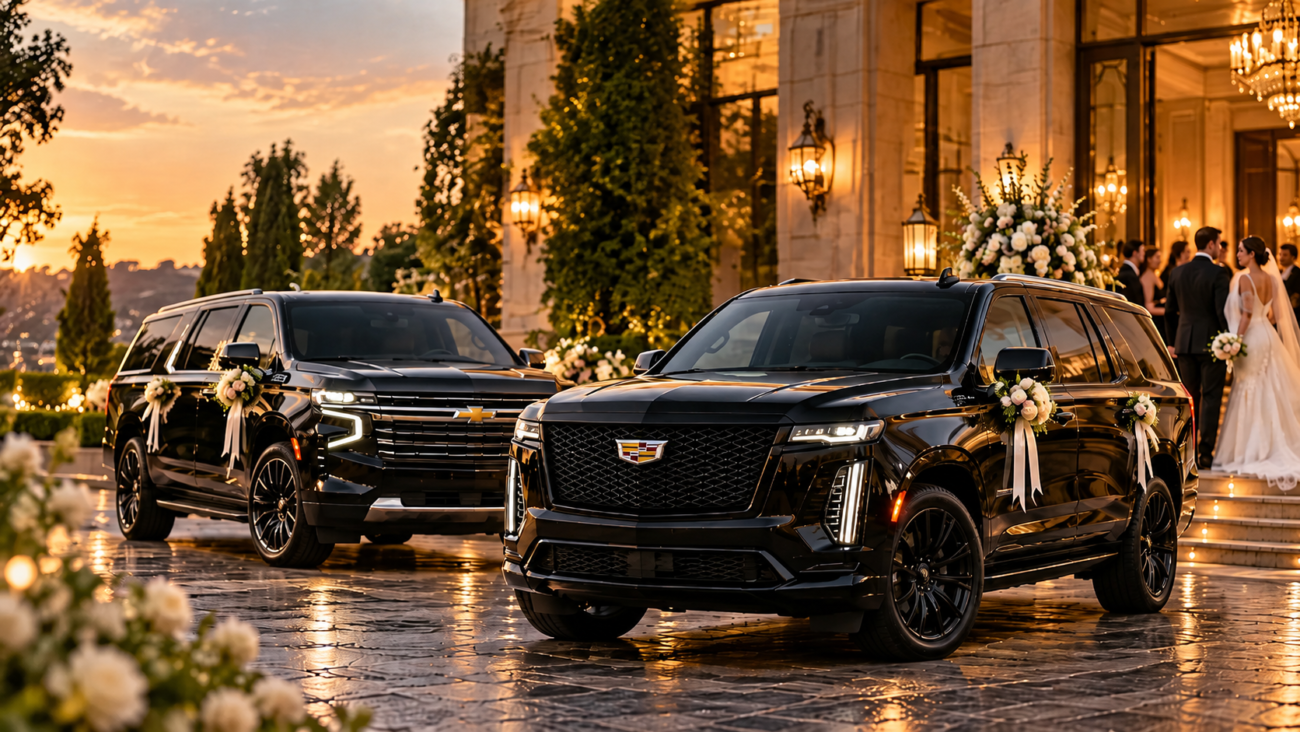
A couple may prefer a private luxury SUV. A wedding party may need multiple SUVs. A larger guest group may require a dedicated group vehicle.
Black Limo Sac currently lists the Chevrolet Suburban and Cadillac Escalade among its fleet. Its current Escalade page specifies seating for up to six passengers and lists weddings and special events among its intended uses.
That makes vehicle selection a practical planning decision rather than simply a style choice.
A Sacramento Wedding Transportation Example
Consider a wedding where guests stay at the Hilton Garden Inn Sacramento/South Natomas and the reception takes place at the Tsakopoulos Library Galleria in Downtown Sacramento.
Visit Sacramento lists the Hilton Garden Inn Sacramento/South Natomas at 2540 Venture Oaks Way and describes the property as part of the Airport/Natomas area.
The Tsakopoulos Library Galleria operates inside Sacramento Public Library’s Central location at 828 I Street in Downtown Sacramento. The library describes the Galleria as an event space that has hosted weddings and other events.
This type of itinerary shows why transportation planning involves more than calculating driving distance.
The Galleria’s own event policies state that its staff works with renters to determine the best entrance based on factors including the number of guests, time of day, and parking accessibility. It also provides a map of the surrounding block for event guests.
For a wedding using a venue like this, your transportation coordinator should confirm the designated entrance and passenger drop-off arrangement with the venue before finalizing the schedule.
A practical route might look like:
South Natomas Hotel → Ceremony Venue → Photography Location → Tsakopoulos Library Galleria → Hotel
“How long is the drive?” is not the only crucial question.
It is:
Where does each passenger group need to be, and by what time?
That distinction helps prevent schedules that ignore boarding, venue access, photographs, and passenger movement.
Coordinate the Ceremony, Photography, Reception, and Return
A multi-location wedding needs one complete transportation plan.
For example:
Hotel → Ceremony → Photography → Reception → Hotel
The couple and wedding party may follow a different schedule from the guests.
The couple might leave the ceremony for photographs while guest transportation moves toward the reception. Later, guests may return to their hotel while the couple remains at the reception.
Create one master itinerary containing:
- Pickup addresses
- Destinations
- Passenger groups
- Vehicle assignments
- Required arrival times
- Photography stops
- Reception departure
- Return destinations
- Transportation coordinator
This should become the single reference document for the wedding planner and transportation provider
Minimize Issues with Parking and Venue Access
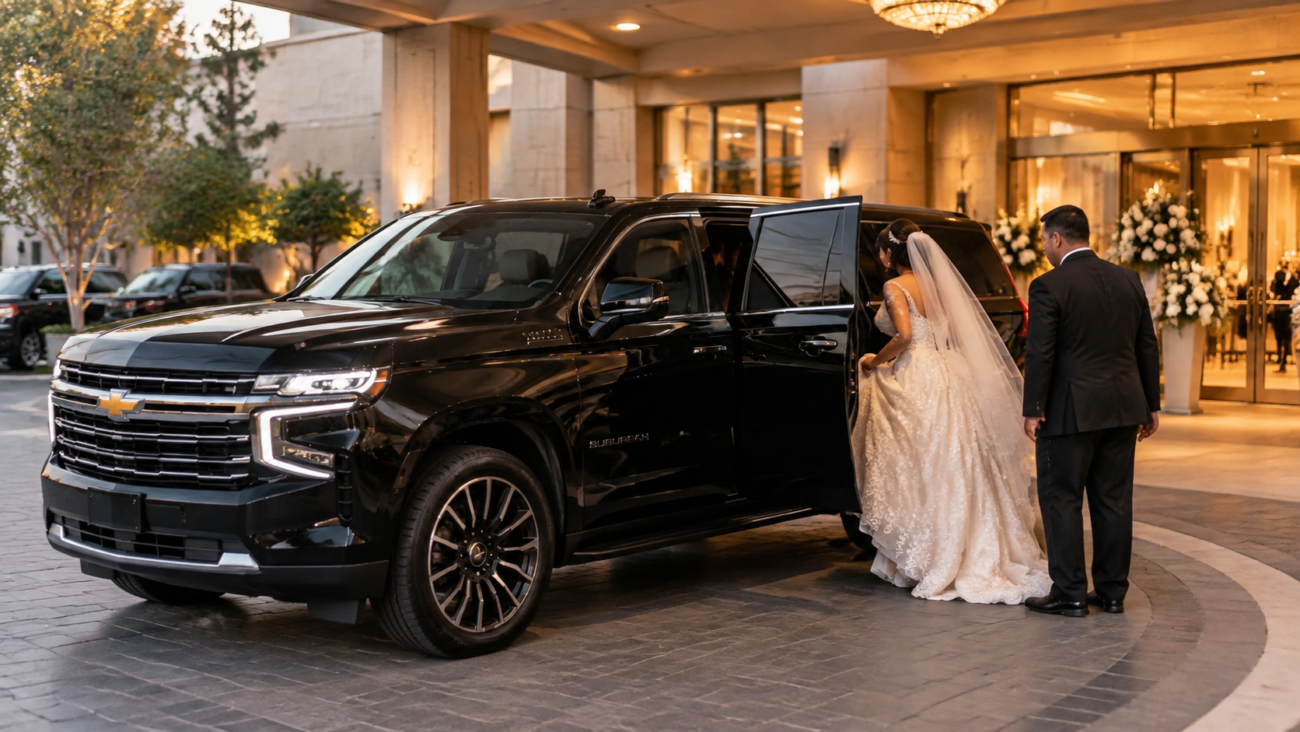
The number of individual cars that arrive at a wedding location can be decreased by using transportation.
That can help when the property has:
- Limited parking
- A little doorway
- Parking remotely
- Long walks
- An area set aside for passenger drop-offs
Before confirming the reservation, ask the venue where passenger vehicles should unload and whether the selected vehicles can reach the designated entrance.
Also confirm:
- Staging areas
- Waiting restrictions
- Loading restrictions
- Valet arrangements
- After-event pickup procedures
These details can affect the transportation schedule more than the driving distance itself.
Do you need valet parking?
Not necessarily.
If the venue has sufficient parking, coordinated guest transportation may solve most of the arrival problem. If parking capacity is limited, valet or parking attendants may complement the transportation arrangement.
Let the venue’s actual parking and loading conditions determine the decision.
Plan for Older, Out-of-Town, and Mobility-Limited Guests
A useful transportation plan considers guests who may need more assistance than the average passenger.
Older relatives may prefer a closer drop-off point. Out-of-town guests may not know Sacramento streets or the venue entrance. Guests with mobility requirements may need additional boarding time.
Identify these guests before finalizing vehicle assignments.
Ask whether anyone needs:
- Extra boarding time
- Luggage assistance
- A closer drop-off point
- Hotel pickup
- Clearer meeting instructions
According to Black Limo Sac’s current wedding service, it provides transportation for guests, family members, couples, and wedding parties. Its chauffeurs help with luggage during pickup and drop-off, according to its advertised service details.
For a specific accessibility requirement, confirm the appropriate vehicle and venue access arrangements directly before booking.
Before the reception ends, schedule the ride back.
The transportation plan only includes getting attendees to the wedding.
The return journey can become more difficult because guests leave at different times and some may not want to drive after drinking.
Decide before the reception:
- First return departure
- Final return departure
- Hotels served
- Guest meeting point
- Person responsible for coordinating departures
A wedding shuttle service can provide scheduled return transportation instead of leaving guests to find their own ride at the end of the night.
If guests need different departure times, plan return waves in advance rather than improvising them after the reception.
Verify the Transportation Provider With Official Sources
A professional-looking website and attractive vehicles are not enough to evaluate a transportation provider.
California provides an objective verification step.
A Charter-Party Carrier (TCP) offers planned transportation for the sole use of an individual or group, according to the California Public Utilities Commission. The CPUC specifically gives a limousine charter for a wedding as an example of TCP transportation.
The CPUC also provides a public carrier search that consumers can use to check whether a carrier has authority to operate. Its consumer guidance recommends checking the carrier’s CPUC license, verifying liability insurance, confirming the TCP number, and obtaining the hiring terms in writing.
The Commission’s limousine guidance recommends obtaining written terms covering items such as:
- Cost
- Deposit
- Refund policy
- Tip policy
- Pickup and drop-off times
- Locations
- Requested vehicle
- Expected services
This gives couples something concrete to verify before they commit.
What about airport wedding transportation?
If your wedding itinerary includes Sacramento International Airport, verify the provider’s current airport operating arrangements as well.
SMF publishes airport-specific ground transportation requirements and permit information for commercial transportation providers operating on airport property.
Sacramento International Airport — Ground Transportation Permits
This matters when you arrange airport pickups for out-of-town wedding guests rather than assuming ordinary venue transportation rules apply at the airport.
Understand Wedding Transportation Cost Before Booking
There is no universal wedding transportation cost because every itinerary creates different requirements.
Your quote can depend on:
- Vehicle type
- Number of vehicles
- Passenger count
- Service duration
- Number of locations
- Distance
- Waiting time
- Multiple pickup waves
- Return transportation
The definitive quote checklist
Give each provider the same information:
- Wedding date
- Pickup addresses
- Ceremony time
- Reception time
- Passenger groups
- Number of passengers
- Vehicle requirements
- Number of stops
- Expected service duration
- Return requirements
Then ask the provider to identify what the quoted price includes and which charges could change.
The CPUC specifically recommends obtaining limousine hiring terms in writing, including cost, deposits, refund and tip policies, pickup and drop-off times, locations, vehicle type, and expected services.
How can you control transportation costs?
You can often avoid unnecessary expense by:
- Grouping guests at practical pickup points
- Matching vehicle size to passenger requirements
- Avoiding unnecessary empty travel
- Combining compatible routes
- Limiting unnecessary standby time
- Finalizing the itinerary before booking
Cost control should not mean exceeding vehicle capacity or removing transportation from guests who genuinely need it.
One Sample Wedding Transportation Schedule
The following example assumes three independently assigned guest vehicles serving the same hotel.
Example: 5:00 PM ceremony and 6:30 PM reception
| Time | Plan |
| 2:45 PM | Wedding-party vehicle arrives at hotel |
| 3:00 PM | Wedding party boards |
| 3:20 PM | Wedding-party vehicle departs |
| 3:30 PM | Guest Vehicle 1 departs hotel |
| 3:50 PM | Guest Vehicle 2 departs hotel |
| 4:10 PM | Guest Vehicle 3 departs hotel |
| 4:30 PM | Final guest vehicle arrives at ceremony venue |
| 5:00 PM | Ceremony begins |
| 5:45 PM* | Wedding party departs for photographs |
| 6:00 PM* | Guest transportation begins moving toward reception |
| 6:30 PM | Reception begins |
| 10:15 PM | First scheduled hotel return |
| 11:00 PM | Final scheduled hotel return |
*These times are illustrative. The actual schedule depends on the ceremony length, photography plan, route, loading time, venue access, and traffic conditions.
The three guest departures represent three separate vehicles, not one vehicle returning to the hotel every 20 minutes.
If you have only one vehicle, your provider needs to calculate the complete turnaround cycle before determining whether multiple pickup waves are realistic.
The final guest arrival should always leave enough time for passengers to reach the ceremony area and settle before the start time.
Put One Person in Charge on the Wedding Day
The couple should not become the transportation dispatcher.
Choose one person to manage transportation:
- Wedding planner
- Day-of coordinator
- Trusted family member
- Designated transportation contact
Give that person the master itinerary and transportation agreement.
They should have:
- Driver contact information
- Vehicle assignments
- Passenger groups
- Pickup schedule
- Venue addresses
- Return schedule
Black Limo Sac’s current wedding service states that its team coordinates scheduling, vehicle preparation, and timing around the wedding itinerary.
That gives the couple one clear communication point while they focus on the ceremony and reception.
Wedding Transportation Etiquette: Who Pays?
There is no universal rule requiring one person to pay for every transportation expense.
The couple, parents, wedding party, or event host may arrange transportation depending on the wedding budget and circumstances.
What matters most is clear communication.
If you provide transportation for guests, tell them:
- Where to meet
- When the vehicle leaves
- Where it will arrive
- When return transportation departs
- Whether additional return trips are available
For gratuity, check the written agreement first. The CPUC’s consumer guidance specifically recommends confirming tip policies in the hiring agreement.
Frequently Asked Questions
Is it rude not to provide wedding transportation?
No. Couples do not have to communicate with every guest. It can be particularly helpful when guests travel from outside Sacramento, parking is limited, alcohol will be served, or several guests stay at the same hotel.
How far in advance should I reserve my wedding transportation?
Start planning once your wedding date, venues, passenger count, and major schedule details are confirmed. Earlier planning gives you more time to secure the vehicle type and schedule you want, particularly for popular wedding dates.
How can I choose the ideal mode of transportation for my nuptials?
Start with passenger count, locations, venue access, luggage, service duration, and return requirements. Then compare vehicle capacity, operating authority, insurance, pricing, written terms, and service details.
Do guests and the wedding party need to ride separately?
They are able to. Separate transportation often gives the wedding party more flexibility for photography and schedule changes while a shuttle keeps guest transportation organized.
Do I need transportation for the rehearsal dinner or after-party?
Not always. Consider it when the event takes place at a different location, alcohol will be served, parking is limited, or many guests do not have convenient transportation.
Make Wedding Transportation One Less Thing to Manage with Black Limo Sac
Your wedding day should be about celebrating with family and friends, not worrying about whether everyone will arrive on time. Having a well-organized transportation plan helps keep the day running smoothly, from the first hotel pickup to the final ride after the reception.
At Black Limo Sac, we provide wedding transportation in Sacramento tailored to your itinerary, guest requirements, and venue locations. Whether you are planning a Downtown Sacramento wedding at the Tsakopoulos Library Galleria or celebrating at another local venue, our team can help coordinate pickups, vehicle assignments, and transportation schedules around your wedding timeline.
Our fleet includes luxury vehicles such as the Cadillac Escalade and Chevrolet Suburban, offering comfortable transportation for couples, wedding parties, and guests. With professional chauffeurs and carefully planned pickup and drop-off arrangements, we help you spend less time managing travel logistics and more time enjoying your celebration.
Ready to make transportation one less thing on your wedding checklist? Book wedding transportation with Black Limo Sac. Share your wedding itinerary with our team, and we’ll help you plan the vehicles, routes, and schedule for your special day.